
You approve a transaction on a familiar DeFi site, expecting to exchange one token for another. Instead of seeing only a contract address and a vague request to “confirm,” you see an estimated balance change, the network involved, and warnings about permissions or unusual behaviour. That difference matters. In DeFi, the wallet is not merely a place to store assets; it is the interface through which you interpret and authorize smart-contract actions.
Rabby Wallet is designed around this problem. Developed by DeBank as a non-custodial wallet for Ethereum and other EVM networks, it combines multi-chain access with transaction simulation and security scanning. Its recent Chrome Web Store presentation continues to position it as an open-source browser wallet for DeFi users seeking a smoother multi-chain experience. The important question, however, is not whether Rabby has more features than a simpler wallet. It is whether those features improve decisions without creating a false sense of safety.
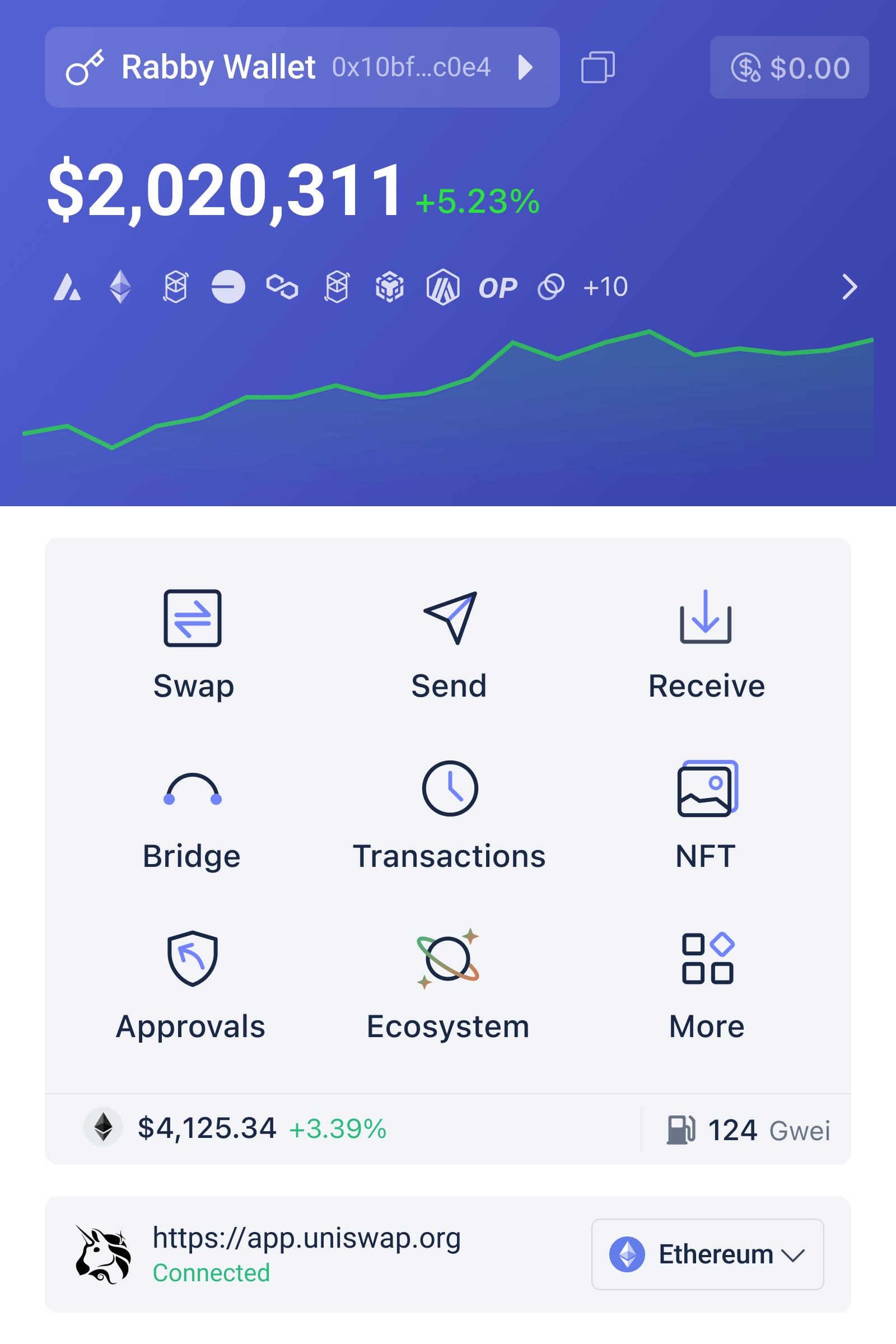
Rabby versus a Conventional Browser Wallet
A conventional browser wallet, such as MetaMask, generally provides the essential functions: it holds or connects to accounts, communicates with decentralised applications, displays signing requests, and broadcasts approved transactions. That model is flexible and widely supported. Its weakness is that the user may have to reconstruct the meaning of a transaction from technical data, especially when interacting with unfamiliar contracts.
Rabby takes a more interpretive approach. Before signing, it simulates the proposed transaction and presents the expected changes to token balances. It also uses a security engine to examine contracts and addresses for signals associated with phishing, known exploits, or unlimited token approvals. In practical terms, this shifts the wallet from a passive signing window toward an independent review layer.
That distinction is easy to misunderstand. Rabby does not rewrite a transaction to make it safe, and it does not decide whether a protocol deserves your trust. It checks the transaction it can observe and explains likely effects. The final authorisation remains yours. This is a useful division of responsibility: the wallet can improve visibility, while the user must still judge context, contract quality, economic incentives, and the legitimacy of the website.
Why Transaction Simulation Changes the Risk Model
The most important security benefit is not a warning icon by itself. It is the separation between what a website claims a button will do and what the transaction is expected to do on-chain. A malicious or compromised interface may describe an action as a token claim while requesting a transfer, a broad approval, or an interaction with an unexpected contract. Simulation can expose that mismatch before signing.
This is particularly valuable for DeFi users in Germany and elsewhere in Europe who move between Ethereum, Polygon, Arbitrum, Optimism, Base, Avalanche, BNB Chain, and other EVM-compatible networks. More networks mean more opportunities for mistakes: the wrong chain, a misleading token with a familiar symbol, an approval that remains active, or a bridge route whose risks are not obvious from the headline transaction.
Still, simulation has boundaries. It is an estimate of the transaction under particular conditions, not a guarantee of future execution or protocol safety. Prices can move, liquidity can change, a contract can behave differently under another state, and a simulation service may not capture every social-engineering risk. A warning system can also produce false positives or fail to identify a novel attack. The correct mental model is “risk reduction through better information,” not “automatic protection.”
Custody, Backend Independence, and Hardware Security
Rabby follows a non-custodial model: private keys remain stored locally on the user’s device and are not sent to Rabby’s servers. This reduces dependence on a central custodian, but it transfers responsibility to the account owner. A lost recovery phrase, malware infection, unsafe browser profile, or careless signature can still result in irreversible loss.
Rabby’s architecture also separates transaction review from key control. It does not create or alter transactions on the user’s behalf, and core signing functions are intended to remain usable even if Rabby’s backend services are unavailable. This is an important resilience property, although some remote security information or interface services may naturally be less available during an outage.
For larger balances, hardware-wallet compatibility with Ledger, Trezor, and OneKey adds another layer. The private key can remain inside a dedicated signing device while Rabby supplies a more informative interface for reviewing DeFi activity. This is often a stronger setup than relying on a browser extension alone. It does not remove the need to verify the transaction on the hardware device, and it cannot protect against a user approving a legitimate-looking but harmful request.
Readers looking for the correct installation path should use the official application source and verify the publisher before proceeding with the rabby wallet extension. Search advertisements, copied websites, and unofficial download pages are part of the attack surface. A secure wallet installed from an impersonated source is not a secure wallet.
Multi-Chain Convenience Has a Cost
Rabby supports more than 140 EVM-compatible networks, including major ecosystems such as Ethereum, Polygon, Arbitrum, Optimism, Avalanche, Base, and BNB Chain. Automatic network switching can prevent a common operational error: connecting to a decentralised application while manually selecting the wrong chain. Integrated bridging through services such as LI.FI and an in-wallet swap aggregator can also reduce the need to navigate several interfaces.
Convenience, however, can compress several decisions into one screen. A bridge is not simply a transfer between folders; it involves smart contracts, validators or messaging systems, liquidity, fees, and settlement assumptions. A swap aggregator may search venues such as Uniswap and 1inch for competitive pricing, but the displayed rate remains sensitive to slippage, liquidity, route complexity, and execution conditions. More automation can mean fewer clicks while making each click more consequential.
The Gas Account feature addresses another practical obstacle by allowing network fees to be paid with stablecoins such as USDC across supported contexts, even when the user lacks the chain’s native token. That can be helpful for occasional users and for moving between networks. Yet fee abstraction does not eliminate fees; it changes how they are funded. Users should still understand the applicable rate, supported assets, and whether the convenience introduces an additional service dependency.
Rabby or MetaMask: Which Fits Which User?
MetaMask remains a broad, familiar choice with extensive dApp compatibility and a large user base. It may suit someone who wants a straightforward wallet and already understands how to inspect contract requests independently. Rabby is more compelling for users whose activity is genuinely multi-chain and who want transaction effects, approvals, and risk signals presented before signing.
The comparison is therefore less about declaring a universal winner than about identifying the dominant failure mode. If the main risk is unfamiliarity with complex DeFi transactions, Rabby’s simulation and scanning can improve the review process. If the main risk is poor key management, changing wallet software alone will not solve it. If the main risk is interacting with a fraudulent website, even a sophisticated wallet depends on the quality of its detection and the user’s willingness to stop when something looks wrong.
Open-source code, released under the MIT licence, improves inspectability and permits community review. It is a meaningful transparency feature, but open source is not equivalent to a complete security audit, and review quality can vary over time. The practical framework is simple: use the wallet’s warnings, simulation, and hardware support together; never treat any one feature as a substitute for operational discipline.
A Reusable DeFi Safety Routine
Before approving a transaction, first confirm the domain and the intended application. Then check the active account and network. Read the simulated asset changes, paying special attention to unexpected transfers and approvals. Consider whether an unlimited approval is necessary; where practical, a limited approval can reduce future exposure. For bridges and swaps, inspect the route, fees, slippage, and destination asset rather than focusing only on the advertised exchange rate.
For high-value actions, use a hardware wallet and compare the wallet’s summary with the device’s signing prompt. Keep a separate account for experimentation, avoid storing substantial funds in a hot wallet, and treat reward programmes such as Rabby Points as secondary to security. Points from swaps, gas funding, or referrals may encourage activity, but incentives should never determine whether a transaction is economically or technically sensible.
The near-term implication is conditional. If DeFi continues to spread across many EVM networks, wallets that translate contract calls into understandable consequences may become increasingly important. Their value will depend on the quality of simulations, warning data, integrations, and user interpretation. The unresolved issue is not whether wallets can display more information; it is whether that information remains accurate and comprehensible as protocols and attack techniques evolve.
Frequently Asked Questions
Is Rabby Wallet safe for DeFi?
Rabby can improve safety by keeping private keys locally, scanning contracts and addresses, and simulating transactions before signing. It cannot guarantee safety. Users remain responsible for protecting recovery credentials, verifying websites, reviewing approvals, and judging whether a protocol is trustworthy.
Can Rabby replace a hardware wallet?
For small or routine amounts, some users may rely on the browser wallet alone. For meaningful balances, hardware-wallet integration is generally the stronger arrangement because the private key remains in a dedicated device while Rabby provides transaction context. The hardware confirmation still needs careful review.
Does Rabby work only with Ethereum?
No. It is built for Ethereum and EVM-compatible networks, supporting a broad range of chains including Polygon, Arbitrum, Optimism, Avalanche, Base, and BNB Chain. Compatibility with a chain does not mean every dApp, bridge, token, or feature carries the same level of risk.
What is the main limitation of transaction simulation?
Simulation describes the expected result under observed conditions. It does not predict every future state, detect every novel exploit, or establish that a protocol is honest. It should be treated as an informed pre-signing check rather than a security certificate.